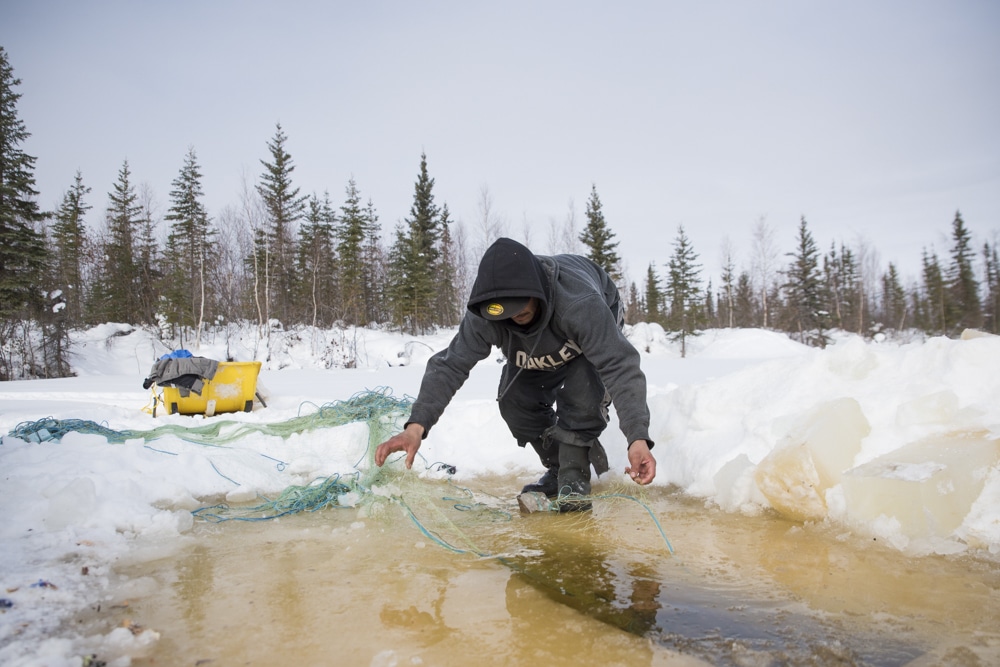
Northern Indigenous communities have always sustained themselves through hunting, harvesting, and gathering food from the land. Today, full-time Hunter and Guardian programs are creating meaningful economic opportunities that support and renew these land-based lifeways.
Communities deeply understand the value of these programs, yet their benefits are often overlooked in funding and policy decisions. Investments in the North are frequently directed toward other food security, health, and economic development initiatives—even though Hunter and Guardian programs effectively support all of these goals.
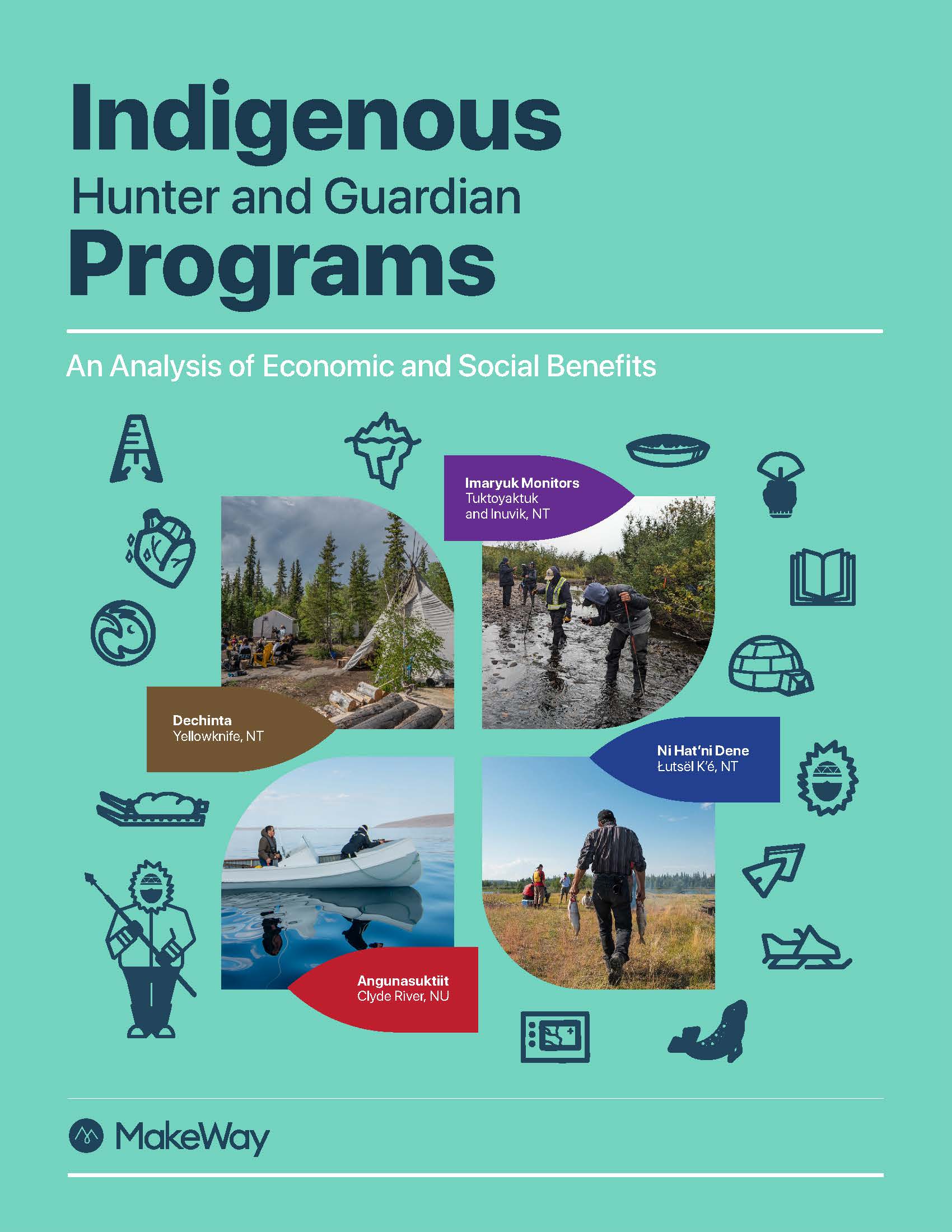
To demonstrate why these are smart, strategic public investments, we partnered with researchers Dr. Shari Fox and Dr. Christina Hackett and four programs—Dechinta, Imaryuk Monitors, Ni Hat’ni Dene, and Angunasuktiit—to track their benefits and calculate each program’s return on investment.
Steve Ellis, our Northern Program Lead, further describes the motivations behind our research and what we learned about the tangible economic and social returns that Hunter and Guardian programs generate.
What role do Indigenous Hunters and Guardians play in northern communities and how has that role evolved over time?
Until very recently, in Northern Canada, people were fully land-based, moving with the rhythms of nature and the animals they depended on. These were professional, land-based people who provided food security to their communities, monitored the environment, safety, and all sorts of stuff. Post-contact, that lifestyle continued to a certain degree due to trapping and fur economies, but the fur economy eventually collapsed, and people increasingly moved into permanent settlements.
A lot of those full-time, land-based professional lifeways have been compromised because people can’t be out on the land all the time. Northern Indigenous peoples have always hunted and harvested, but it’s increasingly an expensive lifestyle with the costs of skidoos, fuel, rifles, and ammunition. People either have to depend on government subsidy programs or go get a job doing something else to subsidize their land-based lifestyle, and then they don’t have much time to get out on the land.
The question in Northern Canada right now is how do we demonstrate the contemporary value of full-time land-based professionals and make contemporary careers out of these lifeways? How do we prove the social and economic reasons for these roles to continue?
How have Hunter and Guardian programs reimagined these roles?
Recently, there’s been two pathways commonly used to revitalize these full-time land-based professions. One is full-time hunting programs, and these are especially present in Inuit communities where hunting professions are the most robust across Canada.
Some of the best hunters in these communities provide massive food security and social benefits to their communities, but they have to cobble together a bunch of other economic opportunities. What if they could focus entirely on that profession of being a hunter, and what value would that bring to community? We’ve seen a number of communities across the North that have built hunting programs through Inuit organizations or not-for-profit organizations that raise money and hire full-time hunters to do just that.
The second pathway is the Indigenous guardian movement across the country, which is about Indigenous peoples stewarding and caretaking some of the greatest biodiversity in Canada. Communities and organizations are mobilizing teams of Guardians to monitor and caretake the land full-time.
In addition to food security, what other needs and issues do Hunter and Guardian programs address in the North?
Mental health and wellness is a big one. There is limited economic opportunity in northern communities, so demonstrating full-time land-based professions are viable and important pathways for Indigenous northern peoples to pursue is incredibly valuable. It’s very important to see that you can be strong and proud in your culture and that has contemporary value going into the future.
One of the biggest disruptions to life in the North is that colonial forces haves said, “Indigenous cultures and lifeways belong in a museum or in the past.” What northern Indigenous peoples are showing is that, no, these are extremely powerful lifeways that have lots of contemporary value. What we hope to demonstrate is that they actually have much more contemporary value than programs that governments pay for in the North right now, and we think there is a better way to allocate public spending in service of northern benefit.
How did MakeWay get involved in supporting this work?
We’ve been funding Hunter and Guardian programs for a number of years. We started in the community of Kangiqtugaapik (Clyde River), where a very awesome Inuit NGO—Ilisaqsivik—wanted to test this idea of employing a full-time hunter. We helped fund a hunter for 18 months, which then expanded into a program of five or six full-time hunters providing services to the community. This model spread to other communities, who have created adaptations or similar programs. The primary job of the Ilisaqsivik hunters is hunting and providing food security to their community, but in other communities, hunting can be part of a broader suite of activities that guardians do.
Northern Indigenous communities know the importance of Indigenous Hunter and Guardian programs. Why was it important to measure their economic value?
What we’re trying to demonstrate here is that these types of roles are essential public services, no different from situating a nurse in a community. In fact, you’d probably have to put fewer nurses or mental health workers in communities if we had more of these types of roles. These are essential services that public governments should be paying for and not just through partial or short-term funding.
It’s obvious how important hunting is in the North—everyone in northern communities understands the benefits. But in places that are far from the North—especially where decisionmakers and policymakers are, like Ottawa or other southern capitals—the realities of these lifeways and the benefits they provide are really quite remote. The only way you could have them intrinsically understand the value is to bring them into community and have them stay for a long time, but we can’t really do that.
The analysis involved translating the value of these programs into economic terms—terms that are easy to understand to policymakers and decisionmakers in the south.
What did the economic analysis reveal about the value of Indigenous Hunter and Guardian programs?
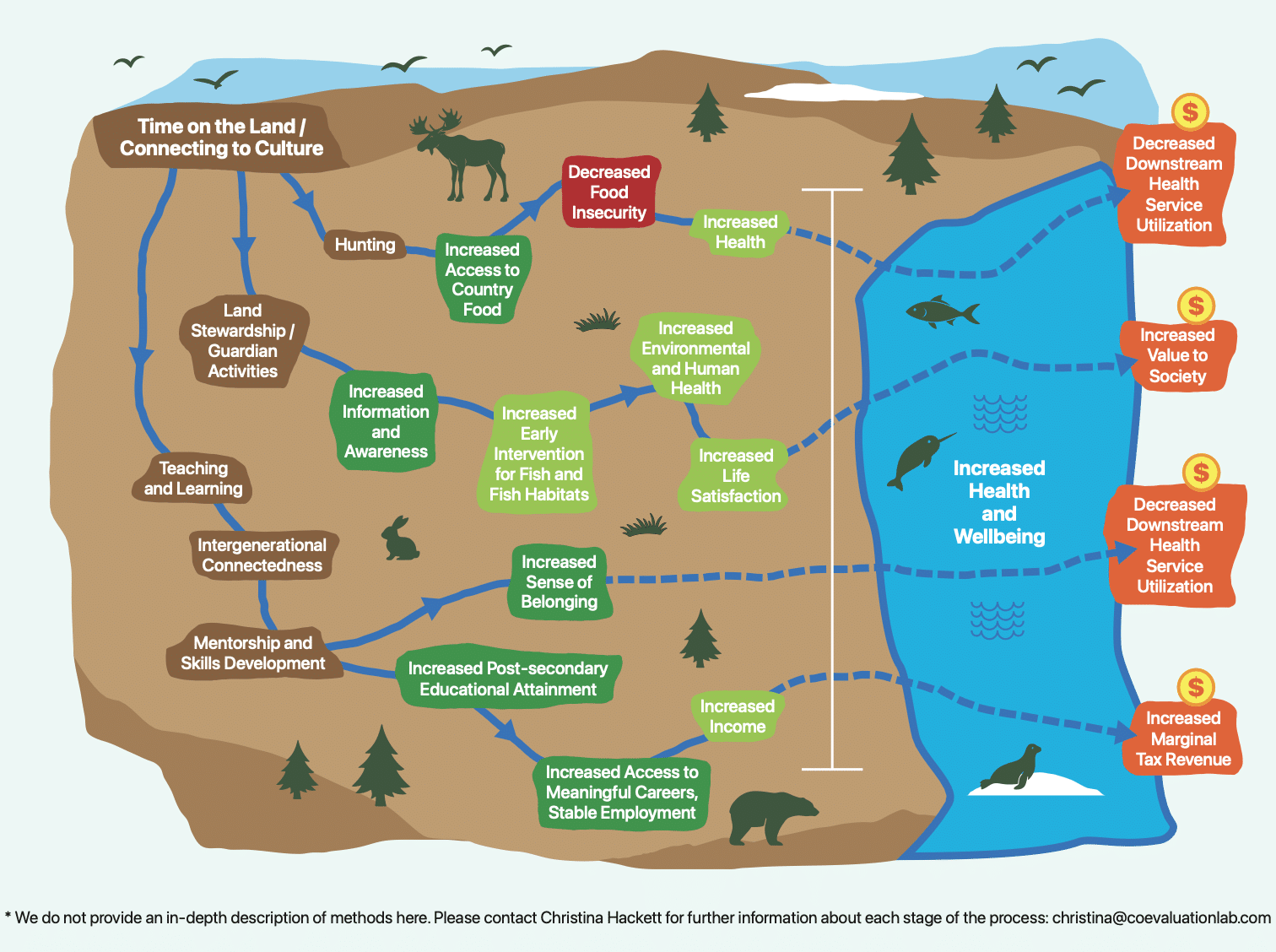
These programs have tangible economic benefits, and the most obvious one is food security. We can easily quantify the amount of meat provided by these programs to community and the cost of buying the same amount of meat at a grocery store. The research found that the programs that were studied harvested an average of $614,000 per year in store-bought equivalent food. That’s an impressive number, but it’s a crude estimate because we know the mental and physical benefits of these programs are much greater than buying an equivalent piece of meat at the store.
Once you start layering on other kinds of benefits—like having people who might not otherwise have employment in good, full-time jobs with benefits—you start to get a more holistic picture of the economic value. Full-time hunters and guardians have a better quality of life and are improving access to healthy country foods for their community, which means a bunch of avoided downstream costs to healthcare and social services. For example, for the Angunasuktiit, changes in life satisfaction resulting from working as a full-time hunter are valued at $4.8 million over the hunters’ lifetimes.
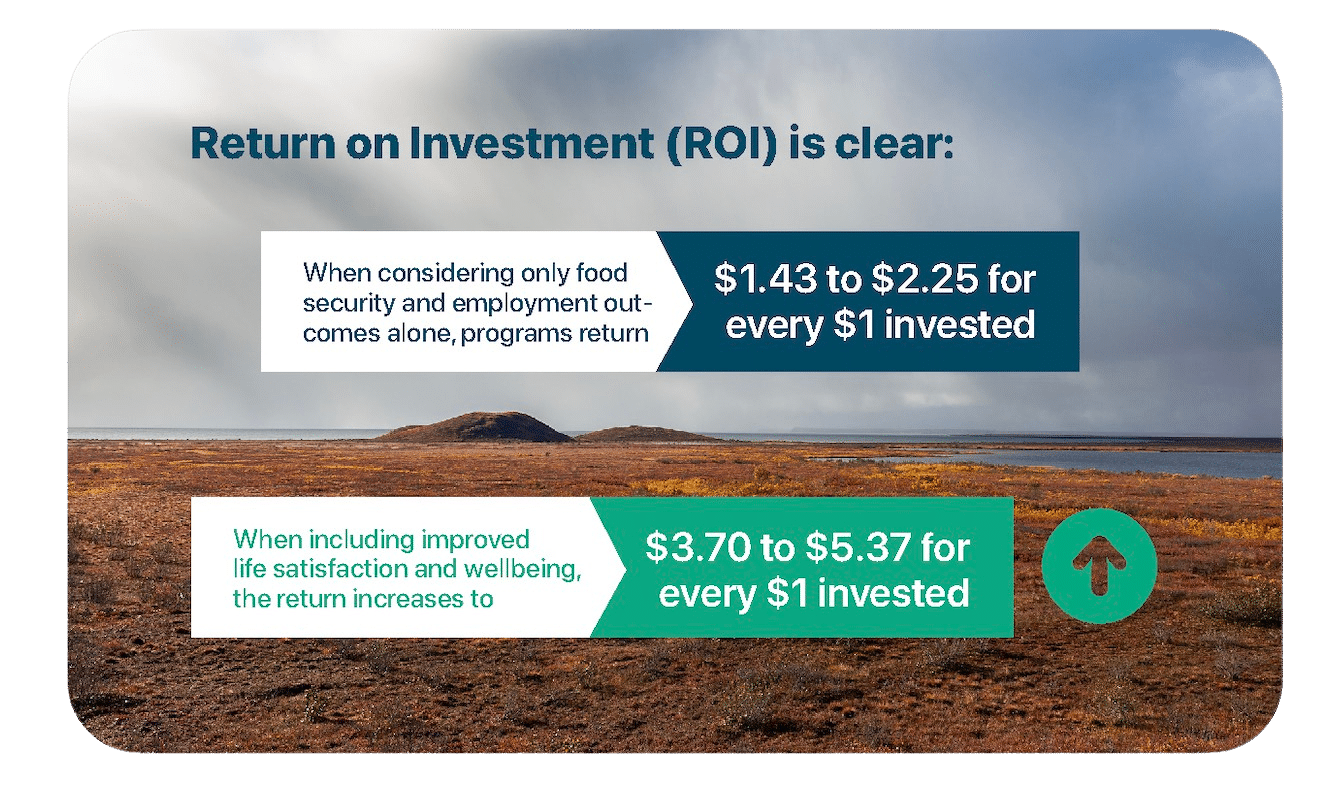
So, when we look at the return on investment, even when you just focus on food security, we’re seeing returns of $1.43 to $2.25 for every dollar invested. When wellbeing is factored in, the return on investment can rise to more than $5.
If we are to support northern food security, should we do that by putting meat in the grocery store or by supporting Indigenous hunters to go get it? There’s a clear economic argument. It makes more sense to make public investments in these kinds of programs because they check all the boxes at a better cost.
Did any of the research findings surprise you?
The biggest one is that when someone is gainfully employed and has embarked on a career doing something they love and is innately grounded in their ways of life and culture, heritage, and history, then those people tend to be happier and healthier people. That means that the people around them are happier and healthier, and that means their community is happier and healthier. Once you start to translate that into economic terms, then you start to see really significant numbers.
How can public governments support Indigenous Hunter and Guardian programs?
The model is proven and these types of programs need sustained funding. We need to make these programs sustainable through major public investments—not through new money but through a reallocation of money currently going to other programs that are not necessarily addressing food security, mental health and wellness, and economic opportunity as well as full-time land-based professions can. Through investments in Hunter and Guardian programs, public governments could collectively check off a bunch of boxes with more impact and more affordably than how they’re using money now. It’s a wiser investment of public dollars to achieve northern Indigenous community-based outcomes collectively.
Download the analysis of economic and social benefits as well as the policy brief.