
Something keeps getting in the way of climate action. It is not a lack of research, nor a lack of concern. EcoAnalytics, a project on MakeWay’s shared platform, is trying to find out why by asking two questions at the heart of Canada’s climate future: what stands between us and meaningful action on biodiversity, and what would it take to shift the country toward renewable energy?
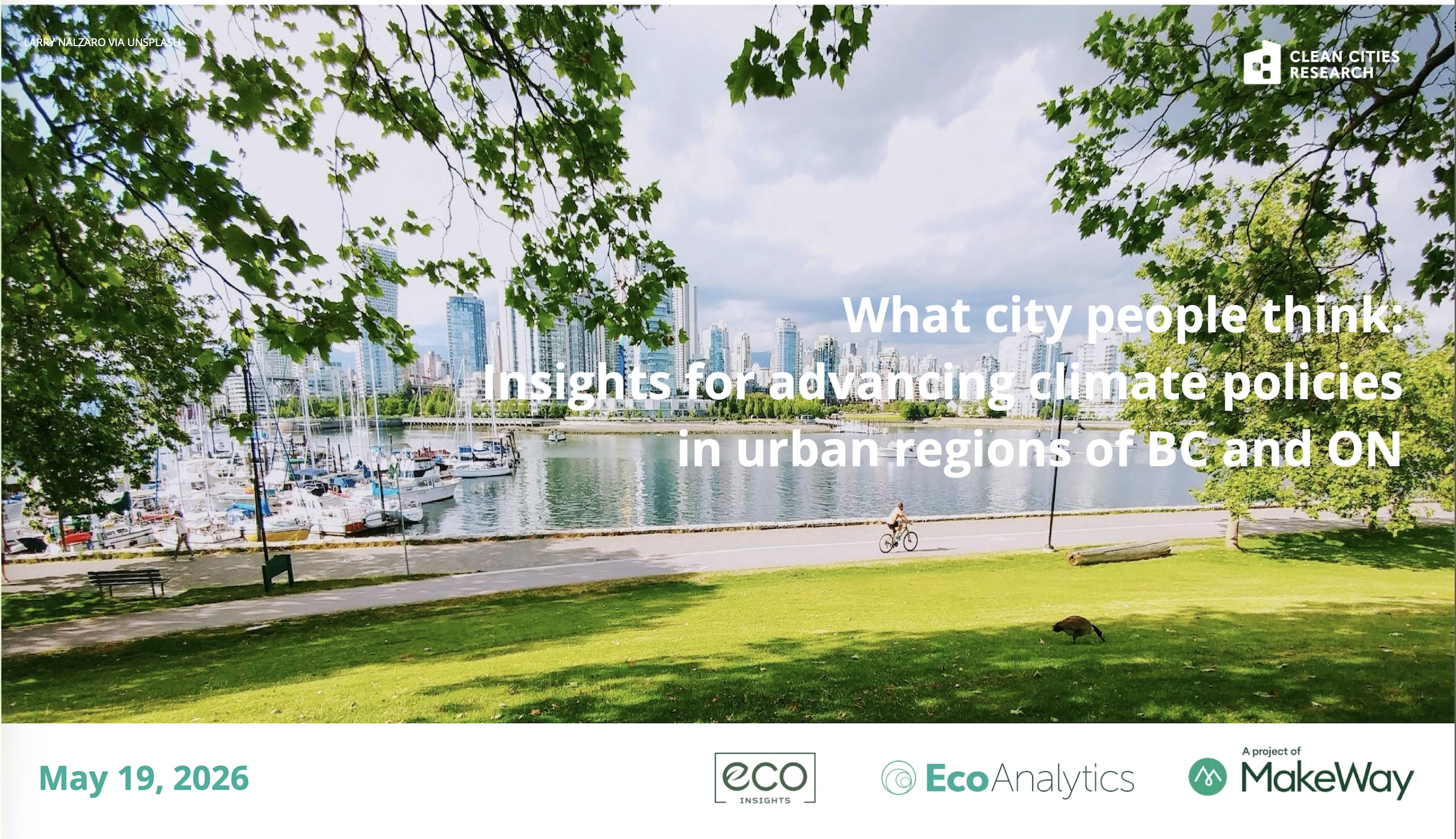
To help answer these questions, EcoAnalytics launched the Clean Cities Research (CCR) project, generously funded by the Ronald S. Roadburg Foundation.
We sat down with Kate McMahon, CCR and EcoAnalytics Project Manager to discuss how this research can help cities make better climate policy. Kate works closely with EcoAnalytics’ members and subscribers to turn public opinion data into communications guidance for key audiences. CCR uses interviews, surveys and focus groups to tackle barriers toward passing climate policy by providing more effective engagement of specific groups of city voters and stakeholders.
The importance of Clean Cities Research
The research is based in four urban regions: Metro Vancouver, Capital Regional District of British Columbia, the Greater Toronto Area, and the Hamilton Area. Clean Cities Research will use qualitative and quantitative findings to create public support around climate policy. The first phase of the project involved in-depth interviews with city staff and elected officials, giving the research team a ground-level view of the real pressures the urban regions face:
“The direct experience of city staff and elected officials, shared through interviews in Phase 1 revealed in a much more concrete way what city staff and politicians are dealing with on the ground with their constituents’ concerns, knowledge and priorities,” Kate says.
But it also found real openings. People respond much better to climate policy when it connects to things they already care about, like lower bills, cooler homes, and affordable housing.
To improve municipal climate policy, the barriers are real and layered. Many Canadians still do not fully understand the causes of climate change or what workable solutions look like. Climate has become a politically charged issue, making it harder for some elected officials to take a clear stand. Deliberate disinformation, spread through well-funded social media networks, adds noise and confusion to an already complicated conversation. And pressing anxieties about the cost of living, housing, and healthcare keep pushing climate down the priority list for many people.
The “curious middle”
In 2023, EcoAnalytics conducted a national survey on climate change that sorted Canadians into five groups based on their political, social, and climate values: progressive activists; civic nationals (socially conservative but environmentally aware); centrist liberals (business-friendly and socially progressive); the disengaged middle (mildly concerned but focused on other things); and populistconservatives (skeptical of climate policy and comfortable with fossil fuels).
“The curious (or moveable) middle are those Canadians in the middle of the opinion spectrum: in this case, those who are somewhat sympathetic to climate action or are at least a little concerned about climate change and its impact on our lives, but probably not doing much about it individually or collectively, and not inclined to call themselves environmentalists.”
The curious middle draws mostly from the civic national, centrist liberal, and disengaged middle groups. These are Canadians who are not opposed to climate action, they are just not engaged with it yet. And that distinction matters enormously. They’re the largest segment of the Canadian population—and the most persuadable. Unlike committed supporters or opponents, they can be moved. Driven by economic anxiety and uncertainty about what climate action means for their lives, they’re the group that determines whether bold climate policy succeeds or stalls.
Learnings from each phase
Earlier this year, EcoAnalytics completed Phase 2 of the project, where its focus shifted to the building industry. Twenty developers and contractors in BC were interviewed about their views on the province’s building emissions rules, specifically the Zero Carbon Step Code, a new tool for the reduction or elimination of greenhouse gasses in buildings in the province.
“We interviewed twenty industry professionals who were in the “curious middle” on this issue, neither early adopters of clean technology and building, nor climate deniers. We learned a lot about how prepared or not they are to begin implementing these regulations and the many other pressures this industry is facing at the moment,” Kate explains.
“This provided good entry points for rethinking how to advance decarbonization advocacy in a more inclusive way. Building owners and operators in Ontario will also be interviewed on their views around building emissions performance regulations.”
The team also recently completed the project’s third phase, which was a large quantitative survey of three thousand residents in urban B.C and Ontario on concerns, support for, and perceived trade-offs around two key municipal policy areas: housing decarbonization and adaptation.
“Some interesting differences emerged between the provinces in terms of support for electrification and energy efficiency as well as key insights into better framing to use when we speak about adaptation. We are now launching Phase 4: qualitative focus groups that will build on the findings of the quantitative research,” Kate says.
Turning research into action
EcoAnalytics’ findings flow directly into the communications strategies and policy documents used by partner organizations such as Zero Emission Innovation Centre (ZEIC), Climate Action Partnership, West Coast Environmental Law and the Community Energy Association
EcoAnalytics is now entering the final research phase, focus groups, which will be followed by a large mobilization effort led by Re.Climate. Training sessions and tool kits will be developed and shared with many stakeholders, including city staff and elected officials in B.C and Ontario, NGO’s and capacity building organizations, building stakeholders and climate communicators.
“We are grateful to the Ronald S. Roadburg Foundation for their generous support of this project but are still needing some funding to complete the knowledge mobilization phase. This phase will be crucial to ensuring the research insights are socialized and shared widely and used to mobilize the public in support of these important policies.”
EcoAnalytics is part of MakeWay’s shared platform – one of many projects advancing innovative social change in Canada by developing solutions to complex environmental and social challenges. The project is now in its final phase of research. Learn more about their work and consider donating toward this important research.