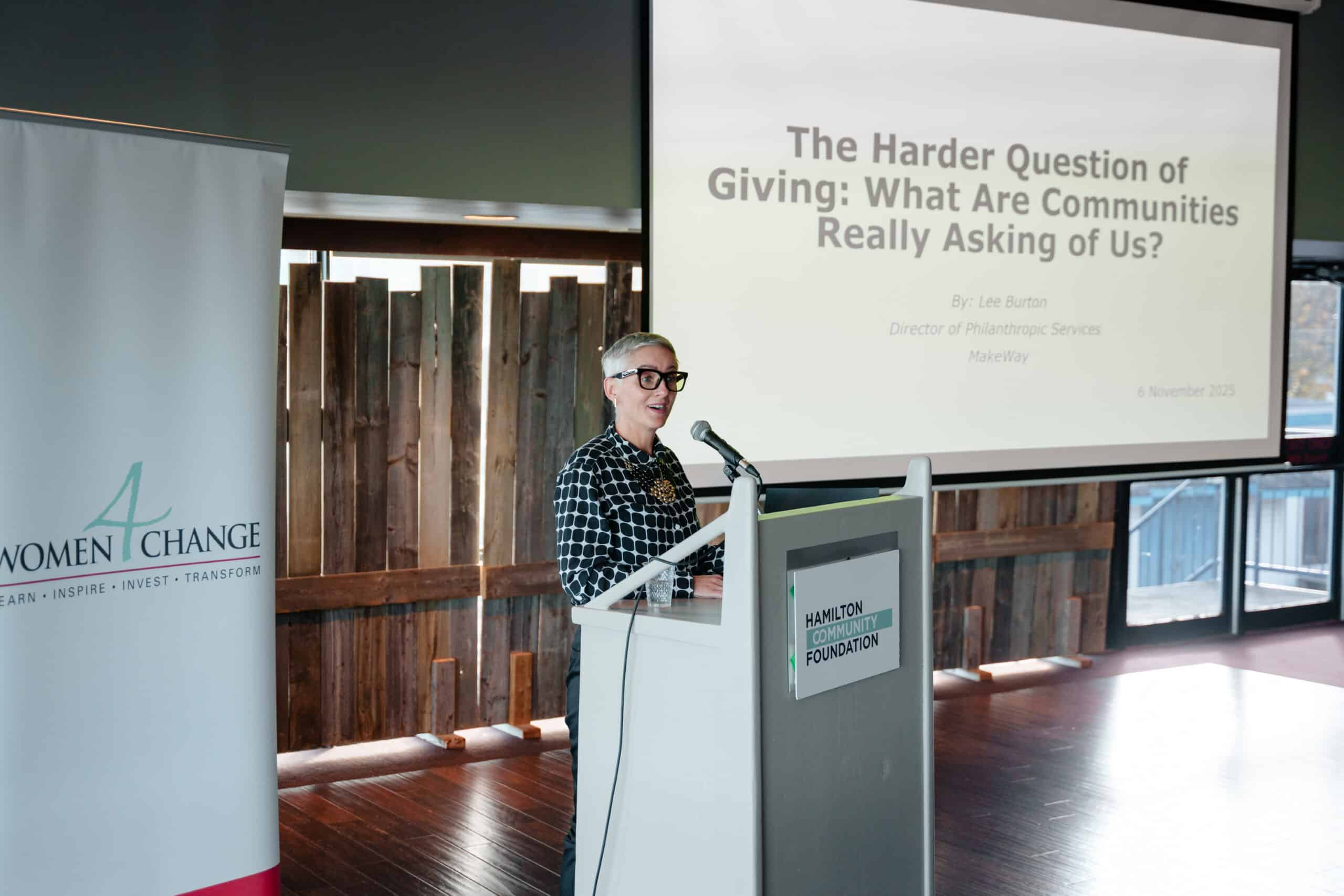
Reflections from a talk at Hamilton Community Foundation’s Women4Change Gathering
by Lee Burton
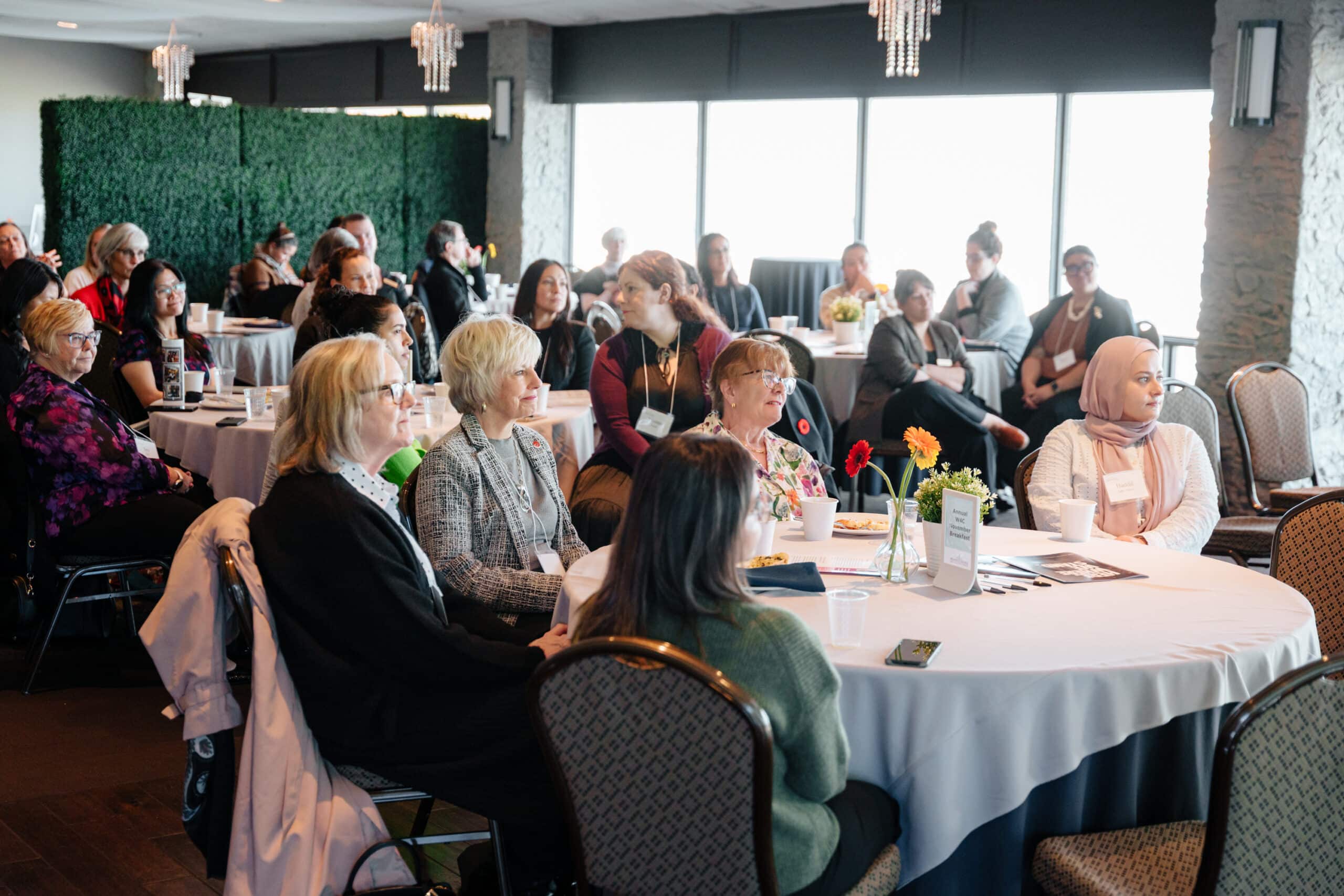
Earlier this fall, I had the honour of joining the Hamilton Community Foundation’s Women4Change community for a conversation about what is emerging in Canadian philanthropy. The room was a beautiful reflection of Hamilton itself, diverse across culture, gender, and generation. I felt humbled to be invited into that space to share what I have been learning over the past ten years in this field.
The reflections that follow are adapted from that talk. They stem from my experience as a Philanthropic Advisor at MakeWay, who, like the Hamilton Community Foundation, bridges donors and community-led initiatives. It is in this role that I have had the privilege of working alongside both community partners and wealth holders in collaborative spaces that aim to shift power and resources toward community-led systems change.
MakeWay only goes where we are invited, and those invitations often come from rural and remote communities asking for support in navigating the charitable landscape and accessing philanthropic dollars. Through that work, I’ve learned many lessons from community partners who have taught me what is most needed from those who traditionally hold power and privilege in philanthropy.
I have reframed these lessons as five invitations, offered to today’s practitioner of philanthropy. I extend deep gratitude to the community partners who have generously shared their knowledge and time with me, guiding me along this journey of learning.
Philanthropy, in the context of systems change, is not primarily about how much or where we give; it is about how we show up in the work.
1. Do Your Own Work
My time with the Right Relations Collaborative has been one of the most profound experiences of my career. For those unfamiliar, this collaborative brings Indigenous leaders and funding partners together to address the inequities and harms rooted in extractive financial systems. Guided by a council of Indigenous aunties from several Nations in the Pacific Northwest, it helps funders learn what it truly means to give responsibly, effectively, and in right relation.
Participation in the collaborative begins with deep self-reflection. Aunties ask:
- Where did your wealth come from?
- What harms might have been caused through its accumulation?
- And what might repair look like?
At MakeWay, we have been part of this collaborative since its inception, three years ago. As the representative, I have also had to do that personal work.
While I do not hold significant financial wealth, I do hold privilege, though for a long time I did not understand where it came from. As an adoptee with no information about my biological family, I had always felt disconnected from my origins. Yet I grew up with housing, food, and financial security, advantages not available to all.
As part of this work, I decided to trace the origins of that privilege through an ancestry DNA test, where I discovered Swedish and Ukrainian roots. During the 2025 National Day for Truth and Reconciliation, I sat down to piece together how my ancestors came to these lands. They likely migrated in the late 1800s, entering through New York, then moving through the Midwest, into Alberta to claim “free land.” Of course, we now know that “free land” was stolen land.
It is painful to recognize that my very presence here may be tied to the dispossession of others, but it is part of the truth I must reconcile. That understanding deepened my awareness of unearned privilege, and I have seen wealthy philanthropists undergo similar reckonings. Tracing inherited wealth to difficult histories can be uncomfortable, but it also opens pathways to reparative philanthropy.
When we know better, we can do better.
Doing our own work, whether we hold financial or social privilege, is the foundation for showing up in ways that communities actually need – with an awareness of how we got here.
2. Be a Good Helper
One of the most transformative collaborations I have witnessed is the Northern Manitoba Food, Culture and Community Collaborative, a community-led network of northern advisors and funders who pool financial, intellectual, relational, and cultural resources to strengthen community connections, advance food sovereignty, and revitalize cultural traditions. The ultimate goal is to repair the harms of colonization in Northern Manitoba.
In this model, funders are not the decision-makers; they are helpers.
By participating in this Collaborative, I learned that to be a good helper means listening first and deeply. It means letting go of deciding who receives funding or defining outcomes. It means asking communities how they want to be supported rather than assuming we already know. It also means taking responsibility for our own learning about history and systems, rather than placing that burden on community partners to teach us. I learned here that change happens at the speed of trust, and trust requires patience.
True partnership cannot be rushed; it grows through being in relationship and spending time.
As a philanthropic advisor, I know how difficult this can be for donors accustomed to structure and control. Yet in my experience, the most effective donors are those who let go, who lean in with curiosity and allyship. When we focus less on directing and more on standing alongside, we begin to show up as communities need us to – following their lead.
3. Be Well
I have been invited several times to the Soul of the Mother Lodge in the beautiful Six Nations of the Grand River Territory. Each visit moves me deeply. Kahontakwas Diane Longboat, a member of the Turtle Clan of the Mohawk Nation, has faithfully carried out her ancestors’ instructions – building a lodge, a sacred fire, and a community of helpers.
Together, they tend a fire that draws people from around the world, guided by a singular purpose: to bring people of all worldviews together in peace and unity. The ceremonies are of an ancient spiritual nature and embody the core values of the Haudenosaunee Confederacy – respect, love, compassion, unity, and peace.
Everyone is welcomed as part of the human family, invited to connect with the Higher Power of their choosing to heal their souls, hearts, minds, and bodies. One can feel the sacred ancestral energy of the fire and the profound intention of the space.
Each time I am there, I feel humbled, sometimes even unworthy, to witness such powerful spiritual and cultural practice. But over time, I have come to understand Kahontakwas Diane Longboat’s invitation: she welcomes us to the fire so that we can all be well.
Because we cannot do the work of reconciliation, repair, or systems change if we ourselves are unwell.
Collective well-being begins with individual wellness.
When we are grounded and well, we are more able to think clearly – with a Good Mind. We can better recognize how patriarchy and oppression show up in our systems, organizations, and even within ourselves. From that place of wellness, we can respond rather than react. That wholeness ripples outward to our teams, families, and communities.
4. Be Bold Enough to Build
The charitable sector can be a rigid environment. Some of that rigidity is necessary; we are operating in a highly regulated space with important compliance requirements. But much of it is of our own making. Over time, we have layered on unnecessary rules and traditions that limit our ability to respond creatively to what communities are asking of us.
Restricted giving. Complex reporting. The pursuit of the highest possible financial returns, even when they undermine social or environmental outcomes. The endowment of capital that could otherwise be moving in the service of justice and community well-being.
Be bold enough to build what does not yet exist. That is what courage looks like in philanthropy.
Before the terms “trust-based philanthropy” and “Impact Investing” were ever coined, philanthropists like Annabelle White were already practicing it. Twenty years ago, Annabelle envisioned investing her inherited financial assets for social and environmental outcomes first, and financial returns second. For years, she was told it could not be done, that financial investment systems did not work that way and that it would be unwise to sacrifice investment gains for social purposes.
But she persisted, experimenting with zero-interest lending, impact investing, and community-led philanthropy. Eventually, she founded Dragonfly Ventures, a women-run family office that integrates impact investing and trust-based philanthropy to advance the well-being of people and planet. People now reach out to Annabelle to learn more about her journey, what she learned along the way, and how to replicate this model.
Annabelle’s story reminds us that when existing structures do not allow us to act in alignment with our instincts and what communities say they need, we can build new ones. That is what Be bold enough to build means: not waiting for perfect conditions or permission, but acting on your instincts and creating the pathways that do not yet exist.
Communities are always evolving. Their needs, leadership, and wisdom are dynamic. To be effective, funders must also stay in motion, listening, adapting, leveraging their resources, and building alongside them.
5. Use Your Voice
Let’s be honest, the patriarchy will not dismantle itself. Communities have been calling for equity, inclusion, and justice for generations. They continue to do so with clarity and courage, often at great personal cost. But it cannot only be community partners calling out the systems that need to change.
If we are to be in true allyship, funders and donors must also use their voices, especially in their spheres of influence. The fight for equity and inclusion should not rest solely on the shoulders of those most affected by inequity, financed by those with power and privilege. We are all in this together.
Allyship is not silent. It is a practice of speaking up, even when it feels uncomfortable.
Your voice matters in boardrooms, donor circles, family foundations, and everyday conversations. Speak about what you are learning. Share how liberating it feels to align your giving with your values and to honour community leadership.
Using your voice does not mean dominating the conversation; it means using your platform to amplify what community partners have been saying all along. It is about standing beside them in solidarity, helping carry the message further, and using your influence to open doors that may still be closed. It often starts with one courageous voice, one person willing to echo what the community has already spoken into existence.
Each time we talk speak up, we create space for others in our networks to do the same. Imagine if every donor, advisor, or foundation leader committed to naming inequity when they saw it, to questioning the systems that keep resources locked away, to sharing the responsibility for change.
That is what communities are asking of us, not only to fund the work of justice, but to join it. Collective change begins when we all use our voices.
Closing Reflections
In summary, the invitations to philanthropy are:
- Do your own work.
- Be a good helper.
- Be well.
- Be bold enough to build.
- Use your voice.
Each invitation calls us to listen more deeply, to examine our place in the system, and to respond in the ways communities are asking us to.
The harder question of giving is not about what we can offer, but about what we are willing to change.
Communities are asking us to bring everything we have – our resources, our relationships, our courage – to the work of repair and renewal. The invitation is here. The next move is ours.
About the Author
Lee Burton (they/she) is the Director of Philanthropic Services at MakeWay, where they lead a Community and Donor Advised Fund program focused on advancing equity and community-led systems change.